Have you ever imagined that our DNA is 98% similar to the DNA of chimpanzees and 60% similar to the DNA of bananas? Only a fraction of a change in sequence of DNA, and we would have been another species. But this similarity proves one thing: we are the descendants of a common ancestor that lived a long time ago on the planet.
Scientists claim that all the life on the planet originated and later diversified from a single ancestor, which they call ‘LUCA’ (Last Universal Common Ancestor). Scientists don’t know how LUCA looked. The question arises here: was there any force that changed the non-living substance into a living being, or was it just the creation of divine being?
History
In the 1780s, Antoine Lavoisier experimented on a guinea pig. He put the animal in a vessel that was filled with ice from the inside. The body heat of the guinea pig melted the ice and released Carbon dioxide. He later put a piece of burning coal in that vessel that could melt the ice and release approximately equal amounts of Carbon dioxide. Lavoisier later concluded that life isn’t complex, it’s just a chemical process.
In the 1790s, Italian doctor Luigi Galvani was experimenting on dead frogs. He hung the legs of a dead frog on a brass hook and unexpectedly, the steel blade in his hand touched the legs of the frog. This triggered a kind of vibration in the frog. Galvani called it animal electricity and thought he might have found ‘Life Force’. But this idea was discarded by Alessandro Volta through an experiment. He concluded that vibration was due to two metals used in the experiment that produced electricity. He later made the first ever battery we use today in our daily life.
Organic substances from Inorganic material
Every living organism is made up of organic substances including Lipids, Carbohydrates, and Proteins. For a long time, it was believed that organic substances could not be made from inorganic material until in 1828, Friedrich Wohler synthesized an organic substance (Urea) from inorganic material (Ammonium Cyanate).
This started a new wave of discoveries in the field of Organic chemistry and chemists started to make Carbohydrates, Alcohols, Carboxylic acids, and other organic substances from just Carbon, Hydrogen, and oxygen, and they could also interchange these organic substances into one another. With this, the concept of ‘Life Force’ started to fade away. But these substances aren’t life; they are just building blocks of life.
Characteristics of Life
Living organisms are different from Non-living organisms by mainly four major criteria which include:
- Complexity: The body of living organisms is complex.
- Metabolism: Living organisms eat food for energy, break down that food to get energy and remove the waste material unlike non-living things.
- Boundary: Living beings are separated from the environment by means of a barrier. In plant cells, this barrier is the cell wall. In animal cells, the barrier is the cell membrane. Skin on other living beings is also a barrier.
- Replication: Living organisms replicate, forming two or more from one organism.
Theories and Hypotheses about Life
A number of theories and explanations have been presented that collectively try to describe how life originated. Some of the theories include:
1) Panspermia theory
According to this theory, life originated in space. We know because of spectrometry. In 1930, with the help of spectrometry, scientists became able to study the composition of distant gas clouds and dust and they found Methylene, Ammonia and Water in it. In 1969, Amino acids were found on the Murchison meteorite. Sagittarius B, a dust cloud twenty-five thousand light-years away was found to have Glycolaldehyde, Ethylene, and Glycol. Glycoaldehyde can react with propenal to form ribose, a central component of RNA. Chirality among these compounds was also found on this cloud.
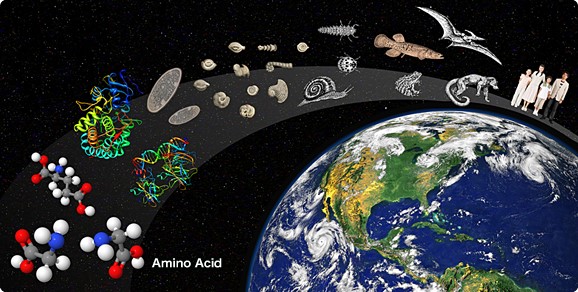
2) Primordial Soup Hypothesis
According to this, life started in a hot pond filled with a rich mixture of inorganic substances. Heat from volcanoes and lightning must have acted as a kickstart for life.
A practical experiment was performed by Stanley Miller and Harold Urey in 1953. They filled a 5-Litre glass container with Ammonia, Methane, and water vapour. They sparked light on the mixture and weeks later they found out that building blocks of life were formed including Amino acids and Carbon compounds.
3) Clay Mineral Hypothesis
This hypothesis tells us about the possible replication in living organisms. According to this hypothesis, the charged surface of clay would have attached the primary organic molecules and sped up the chemical process between them. This would have resulted in the long nucleotide chain and ultimately in RNA capable of storing genetic information and replication.
4) RNA World Hypothesis
This explains that RNA must have come first and later proteins were made and DNA was formed. When fatty acids were formed and turned to lipids, they started to form bubbles in water because of their hydrophobic part. These bubbles must have trapped the chemical inside, and lipids must have acted as primitive cell membranes. Possibly, RNA must have been trapped inside any bubble forming the first Prokaryote and marking the origin of life and the boundary between living and non-living.
5) Hydrothermal Vent Theory
This explains that life started near volcanic vents on the ocean floors. The water near these volcanic vents was rich in minerals and was hot too. The first ever living organisms would have used this water for energy. Fatty acids would have taken the nutrients in the water inside, used for energy and would have excreted out the waste minerals. This is believed to be the first ever and simplest kind of metabolism in the living organism.
At first, life was simple, based on a single cell. But later, it evolved to multicellular and became complex. Some single-celled prokaryotes would have eaten other single-celled organisms or might have formed mutualism. The explanation given by scientists about the evolution of multicellular life from single-celled prokaryotes is the possible merger of Bacteria and Archaea. A bacterium would have come closer to arches and might have got trapped inside, forming the mutualism and origin of multicellular life.
When Lynn Margulis researched mitochondria, she found out that Mitochondria has its own DNA that is similar to the Typhus Bacteria. Mitochondria would have been a bacterium that formed mutualism with another organism. Life later evolved, slowly and gradually, animals started to roam on the planet and ultimately Homo Sapiens came into existence. The first ever life is estimated to have started some 3.7 to 4 billion years ago while the origin of multicellular life can be traced back to 1.5 billion years ago.
No matter how life formed or how we came to exist, one thing is clear: we are made up of star dust. An intelligent combination of star materials that can think.