Early life and education
Many great scientists have been born over the years who have contributed to science. Galileo Galilei was one of them. Galileo was born in Pisa, Italy, in 1564. In the same year Michelangelo died, Shakespeare was born.
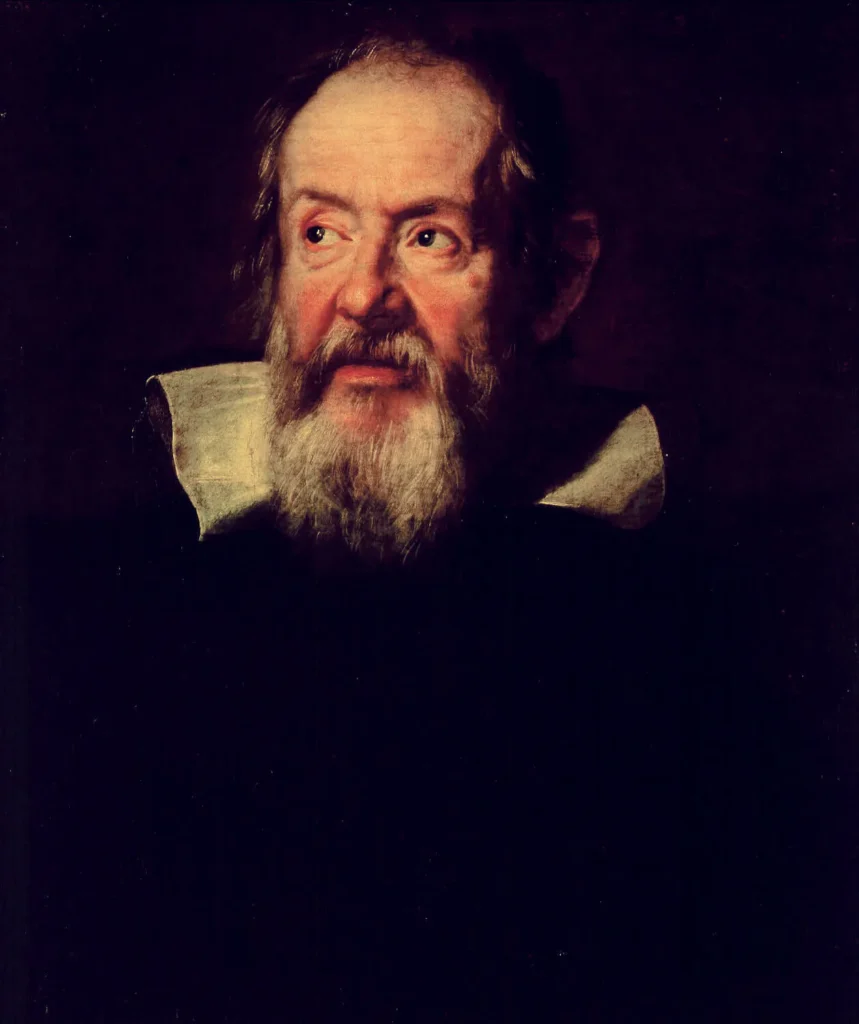
At the age of eight, Galileo moved to Florence. His father insisted that he should study medicine at the University of Pisa. Though he wasn’t passionate about medicine, he loved mathematics and science. So he left the University of Pisa in 1585, just 4 years after his enrollment, without getting a medical degree. In the same year, he started teaching mathematics at Florence. Three years later, he came back to the University of Pisa, this time not as a student but as a professor of Mathematics.
Leaning Tower of Pisa experiment
At that time, Aristotle was believed to be among the most influential natural philosophers. Everyone believed in the Aristotelian idea that objects would fall at a rate proportional to their mass. According to this, a ball of 5 kg would fall earlier than a ball having a mass of 1 kg.
Galileo highly doubted that idea. To prove this wrong, he climbed the Leaning Tower of Pisa and dropped one heavy and one light object of roughly equal physical size. He observed that both objects struck the ground at the same time.
This happened because we now know that the force of gravity is directly proportional to the mass. The more mass, the stronger gravity pull. But the more massive an object, the more force is required to accelerate the object. So, the additional force of gravity perfectly cancels the additional force required to accelerate objects, thus all objects fall at the same rate in a gravitational field, if we ignore the air resistance.
Ptolemy’s views and Galileo’s telescope
After three years in Pisa, Galileo went to Padua near Venice, where he would work as a mathematics professor for the next eighteen years. At that time, the Catholic church and almost everyone believed in the Ptolemaic view of the universe; the sun and all other heavenly bodies rotated around the Earth. Aristotle long ago had proposed that everything above Earth was perfect and incorruptible.
Although few astronomers believed in different systems. Like the Danish astronomer Tycho Brahe, he believed that all the planets and stars rotate around the sun and the sun rotates around the Earth. Meanwhile, Copernicus had argued that everything in the solar system revolved around the sun. He had written this in his book “On the Revolutions of the Heavenly Spheres.” He had died in the year when his book was published, but his book didn’t get any major support at that time.
In 1608. Glassmakers in the Netherlands were making great progress in glassmaking. Using these glasses, Hans Lipperhey from Middleburg created the first ever telescope. On October 2nd, 1608, he submitted his invention for a patent, in which he described the telescope as a Dutch perspective glass used to see things far away as if they were nearby. The word of the invention spread to Europe and ultimately to Galileo in June 1609. This telescope could magnify things three times their original size. Galileo thought he could do better.
Galileo came back home to Padua from Venice and started working on making a telescope of his own. In the first few days, he designed a Prototype and in a few months, he invented a telescope capable of increasing human visual capabilities by eightfold. Before turning his telescope to stars, Galileo demonstrated its abilities to Venetian Lawmakers, offering them as a gift. Due to its military potential, they accepted the gift. Galileo’s final telescope was approximately 1.2 meters long, 37 millimeters in diameter, and capable of magnifying objects twenty times.
Discovery of moons of Jupiter
After completing the telescope, Galileo was about to do what humanity had never done before. He pointed the telescope at the moon and found out that the moon’s surface has craters, grooves, and mountains. This was in contrast to the belief that the moon’s surface was perfect and smooth, unlike the Earth.
After three months of this amazing discovery, at around 5 pm on Thursday, 7th January 1610, in the garden of Padua, Galileo pointed his telescope towards Jupiter. He observed three fixed stars extremely close to Jupiter. After a few subsequent nights, Galileo observed that the objects appeared like satellites around Jupiter. After six days, he observed the fourth object orbiting around Jupiter. They seemed to change their positions relative to Jupiter, but always stayed in a straight line. Those were the moons of Jupiter: Io, Europa, Ganymede, and Callisto, which would forever be known as Galilean moons.
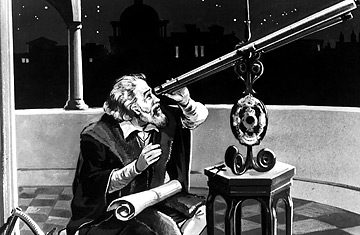
He published his findings in a short book named ‘Sidereus Nuncius’ (The Starry Messenger). People disagreed and called his telescope defective. This was a totally new idea for people at that time, that anything could rotate Jupiter. But the people offended the most were the people of the Catholic church.
Heliocentrism and Pope’s decree
Galileo argued for the heliocentric model of the solar system that everything in the solar system revolves around the sun. He stated that scriptures can’t contradict what’s true in nature. In 1615, he wrote a letter to the Grand Duchess Christina of Tuscany in which he stated that:
Church and Science are compatible. But if science is true in the natural world, it is unreasonable for the church to expect scientists to ignore their discoveries and blindly trust the interpretations of scripture.
Pope Paul V sent Cardinal Robert Bellarmine to visit Galileo a month before they banned heliocentrism. Bellarmine was instructed to tell Galileo about the upcoming decree, as it would make his work heretical. Next year, in 1616, the Pope decreed that heliocentrism was heretical due to being false and contrary to the church’s scripture. They also banned Copernicus’s book on heliocentrism until corrections were made that essentially removed all the suggestions of Earth orbiting the sun.
Galileo’s observations
Galileo quantified his observations and he measured the orbital period of Jupiter’s moons. As he went on and on to observe, the orbital periods became more precise. But something was off. He observed that orbits seemed to be inaccurate because Earth was in orbit around the sun. By counting for the motion of Earth around the sun, his problems were solved. This discovery did not hold with the principles of Aristotlean cosmology. Astronomers and philosophers refused to believe an ordinary man like Galileo at that time. When he pointed his telescope at Venus, he observed that Venus showed phases like our moon each month. He concluded that Venus must also be revolving around the sun.
A dialogue concerning two chief systems of the world
Seven years after the Cardinal’s visit, Galileo’s friend became the new Pope. He discussed heliocentrism with the Pope, and they agreed that he could write about it in a theoretical way. In 1624, Galileo started writing a book, and in eight years, he completed the book by the name ‘A Dialogue Concerning Two Chief Systems of the World’. In this book, he wrote about two fictional characters, Salviati, who argues for the heliocentric Copernican system, and Simplicio, who is a follower of Aristotle, arguing that Earth is at the centre of the Universe. Salviati easily wins the argument, suggesting that Galileo’s views were correct.
The Pope read the book and got furious. The Roman Inquisition banned the sale of the book and called Galileo to trial for heresy in 1633. At that time, he was 70 years old. The proceedings were conducted by ten cardinals, all appointed the Pope to protect the Catholic beliefs.
Trial of Life
Church asked Galileo what he remembered of his meeting with Bellarmine. He stated that he was informed to speak lightly of the heliocentric model. No truth was taken from it as it went against the catholic beliefs. He was called a liar. To prove this, the prosecution produced a letter that Bellarmine had supposedly sent to Galileo after they had met. In it, Bellarmine had informed Galileo not to hold, teach, or define heliocentrism in any way possible, either orally or in writing, otherwise the holy office would start proceeding against him.
But Galileo was a wise man; he kept records of his own. He brought out the original copy of the same letter he had received from the cardinal, written and signed by Cardinal Bellarmine. Galileo’s original copy didn’t say that he was ordered not to talk or write about heliocentrism in any way whatsoever, or that he would be persecuted if he did. Rather, it stated that heliocentrism is wrong and shouldn’t be advocated for. Since the dialogue was a fictional story, Galileo did not break any rules.
The church’s letter had that one key addition that was the basis of the trial. The trial went on for weeks, and they ultimately convicted Galileo of heresy for his opinion that the sun is at the centre. Galileo was sentenced to live under house arrest for the rest of his days. His books were banned, and anything he might write would be prohibited. But he decided to write, and he wrote a book by the name ‘Discoveries and Mathematical Demonstrations Concerning the Two New Sciences.’ The book was smuggled out of Italy and was later published in Holland. Einstein praised Galileo’s work and tagged him ‘The father of modern science.’
Final resting place and middle finger
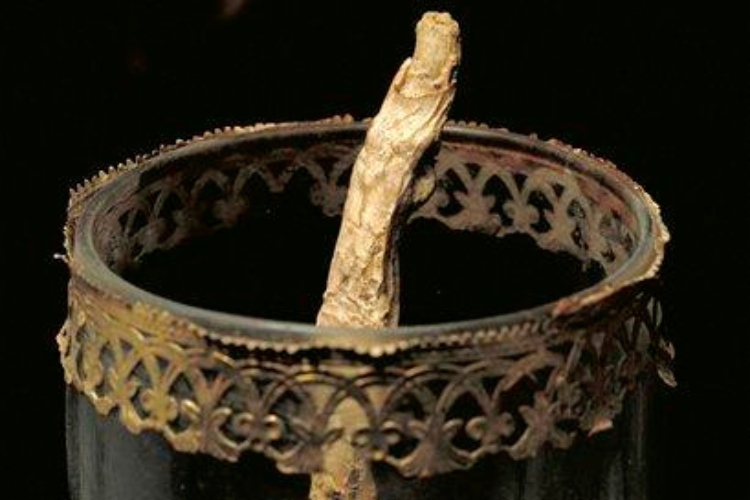
Galileo breathed his last on January 8th, 1642. He was buried in a small room next to the Novice Chapel at the end of the hallway. After nearly 100 years, he was moved to the main body of the Basilica. In this move, his three fingers, including the middle finger and a tooth, were removed and placed on Display in the Galileo Museum in Florence, Italy.
In 1718, the ban was lifted on his books. His books were reprinted except for the dialogues. In 1835, the ban on his dialogues was also lifted, and his total work was republished and distributed worldwide, keeping his legacy and resistance that would live forever.