The Earth is our home, where millions of species survive. It is quite possibly the only planet in the entire universe that sustains life. However, our home was once just a land covered in layers of lava—a place of raining fire and temperatures so high that the possibility of life was unimaginable. This was our Earth, some four billion years ago.
Solar Nebula and the formation of Sun
4.6 billion years ago, our solar system had not yet formed. A dust cloud containing high amounts of hydrogen and helium drifted through space. When a dying star exploded as a supernova, it emitted a shockwave. This shockwave, combined with gravitational instability, caused the gas and dust particles in the solar nebula to compress and squeeze inwards. These particles began to move like a flat, rotating disc, known as the protoplanetary disc.
As a result, pressure and temperature increased at the center, leading to the formation of a protostar. Mass concentrated at the core where, due to extreme heat, a nuclear fusion reaction began. Generally, at temperatures around 15 million degrees Celsius, hydrogen undergoes nuclear fusion to form helium. This process, along with the high concentration of mass at the center, created our Sun, which now constitutes 99.8% of the mass of our solar system.
Accretion and formation of Earth
In the rotating protoplanetary disc, the remaining 0.2% of mass formed planets, moons, comets, and asteroids. As dust and gas particles collided and combined, their size increased from 1,000 meters to 100,000 meters. This ongoing cycle of collision created planetesimals. When these planetesimals merged, protoplanets formed, a process known as accretion. Soviet scientist Victor Safronov first described this process in 1969, and astronomers have since observed accretion in other nebulae. More evidence of this process can be found in the chondrules of meteorites, which contain Uranium and Hafnium. Interestingly, the Uranium on Earth is about 6 billion years old, making it older than the solar system itself.
It took millions of years for protoplanets to develop from planetesimals. Constant collisions between these bodies caused the protoplanets to grow and become spherical due to gravity. This intense activity generated a lot of heat, creating thick layers of molten lava. Thus, from this immense chaos and collision, our Earth formed roughly four billion years ago.
Hadean Eon
The time period when protoplanets struck Earth is known as the Hadean Eon era. It lasted from 4.6 billion years to 4 billion years ago. In this era, water on Earth formed. When asteroids and comets struck Earth, they contained water molecules. Even Earth has some of its own water because the Solar Nebula, from where all protoplanets formed, had ice crystals. In the Hadean Eon time period, Earth was like hell, a ball of magma and covered in layers of lava.
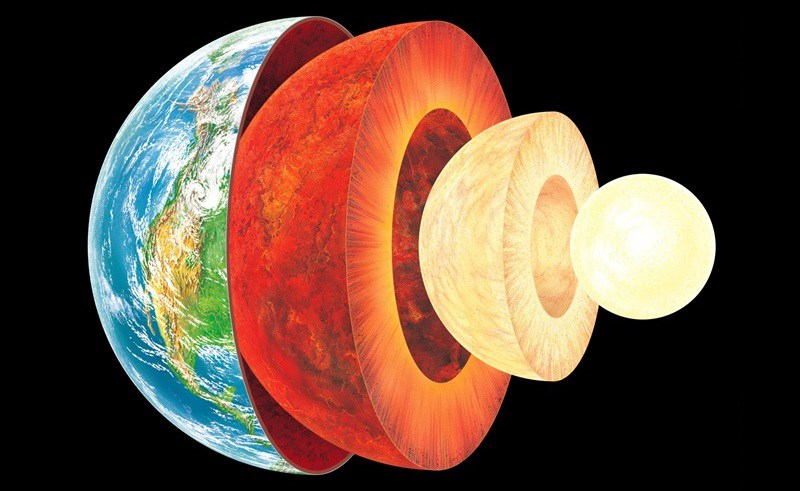
In the first 100 million years of this era, layers of the Earth formed through a process called differentiation. Due to the gravitational force, the heavier metals like Iron and Nickel were pulled to the centre of Earth, and lighter elements like sodium, silicon, Oxygen, Potassium, etc started to float upwards in the layers of lava. This is known as the Iron Catastrophe.
This created the layers of Earth – Crust, Mantle, and Core. The temperature at the core is 6000 degrees Celsius. This is so high that it can actually melt the iron present at the core, but because of the high pressure of the Earth’s core, iron is in a solid state at the core. The mantle is 3000 kilometres long layer consisting of radioactive decaying material. Currently, it is in a solid state, but in the past, it was a layer of molten magma. Crust was formed, and it contained 46% Oxygen bounded in rocks and minerals.
Nowadays, we know about all this because of these techniques;
- Radiometric dating: A technique to calculate the age of material by measuring the decay rate of radioisotopes.
- Comparative Planetology: A technique to compare the materials and rocks of Earth with those of other planets.
- Computer simulation: A technique using advanced computers to simulate the process.
Physical layers of the Earth
There are five physical layers of the Earth. They were formed in the late Hadean Eon and stabilized in the later Archean Eon. The following are the physical layers of the Earth:
- Lithosphere: It includes the rigid crust and rigid upper mantle. Generally, oceanic layer is 100 kilometres thick, whereas continental layer is 280 kilometres thick. The layer is not continuous; it contains Tectonic plates. When the boundaries of these tectonic plates meet, volcanoes are formed, and when the boundaries of these tectonic plates rub against each other, earthquakes occur.
- Asthenosphere: It constitutes the upper mantle, a 140-kilometre-wide highly viscous layer.
- Mesosphere: This layer includes the lower mantle. It is a transition zone where denser rocks form. For humans, it is impossible to extract these rocks. They usually come on the surface in volcanic eruption or in a meteorite strike.
- Outer Core: It is 2200 kilometers thick, a liquid layer. This liquid layer churns the iron particles, and thus, due to heat, a fluid convection current is produced because iron is a good conductor of electricity. Due to this electric current, Earth has its own stable magnetic field that is an important reason for the survival and sustenance of life on the planet. This magnetic field prevents the dangerous charged particles from the sun and solar winds from reaching the Earth.
- Inner Core: It is a solid, dense sphere composed of Iron-Nickle alloy. The radius of this sphere is roughly 1200 kilometres. This layer is growing 1 millimeter each year.
Formation of the Moon
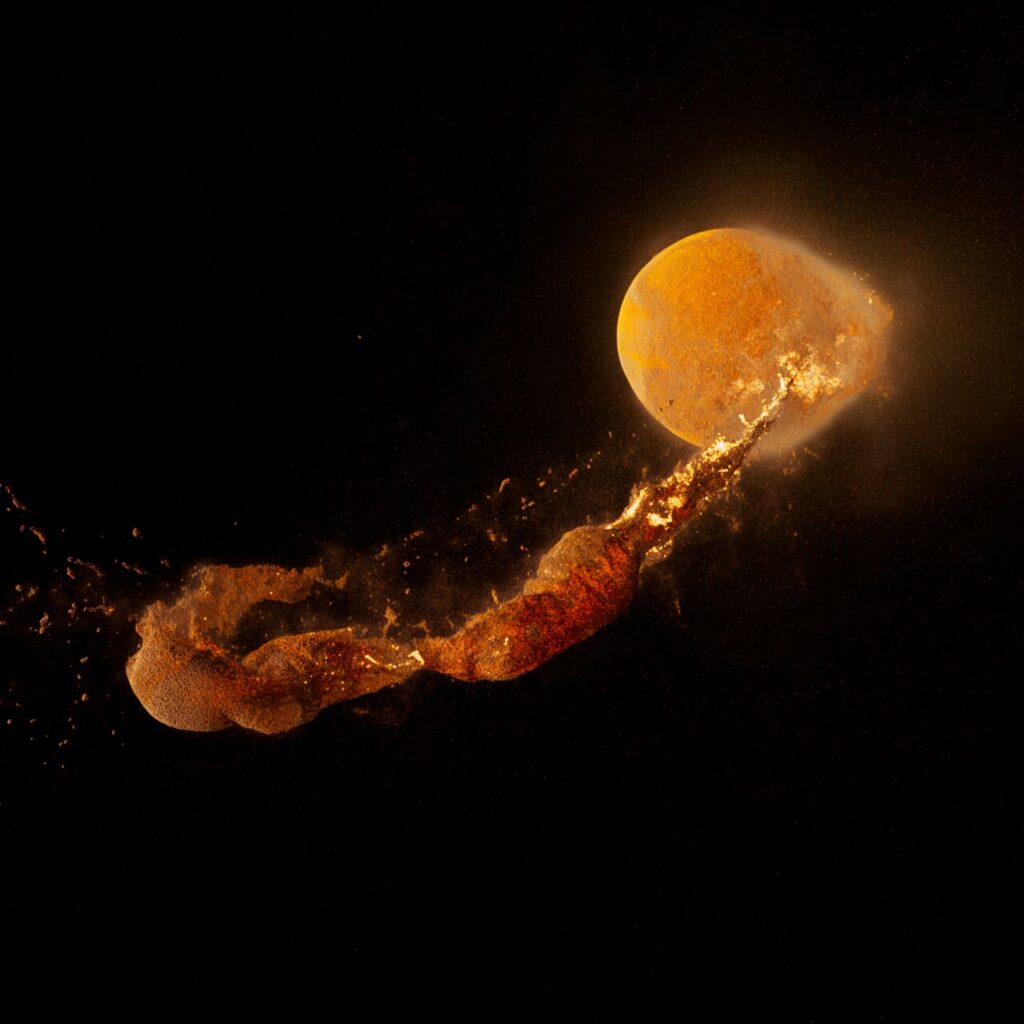
Our moon was formed in the Hadean Eon time period. Though several hypotheses have been made about how our moon was formed. The best possible explanation is the Giant Impact hypothesis.
The giant impact hypothesis states that a protoplanet the size of Mars would have collided with Earth, 100 million years after the formation of the Earth. This protoplanet is named Theia. The cores of Theia and Earth would have been mixed, and a big part of this would have become the moon. At the time of collision, most of the Iron had been settled in the core, and the moon is said to be likely part of the Earth rather than Theia because Earth’s 30% mass is an iron-rich core; the core of the moon is only 1.6%-1.8% of the total mass. This hypothesis is based on the evidence of the same chemistry of basaltic rocks from the Moon that the Apollo 11 astronauts brought to that of the Earth’s basaltic rocks.
Other explanations that suggest the formation of the moon include:
- The capture theory: This suggests that the moon would have been a planetary object captured by Earth’s gravity.
- Co-formation theory: This theory explains that the Moon and the Earth would have been formed at the same time, and the Earth’s gravity would have caused the Moon to revolve around the planet.
- Fission hypothesis: This explanation proposes that the Earth would have been rotating so fast that its parts, where the Pacific Ocean now lies, would have been torn apart to form the Moon.
Conclusion
When Earth cooled, water vapour condensed and clouds formed. Continuous rain for millions of years formed the oceans we see now. But when we look at a large scale, everything looks like it was planned and executed with immense perfection. The 23.5-degree tilt in rotation after colliding with Theia that formed the seasons on Earth, the position of the Earth in a Goldilocks zone from the sun, the perfect size of Earth, a stable magnetic field, the right concentration of gases, and sufficient volcanic activity. All these things suggest that our chances of being born were near impossible, yet we are here, on this beautiful planet. All we have is just this planet, a little dot in the universe, representing life.