Around 100 million years ago, there were no humans on the planet, but dinosaurs roamed the Earth. Some in size higher than modern-day buildings with strong teeth, and some have a speed of up to 90 km/h. Dinosaurs ruled the Earth for nearly 170 million years. Let’s learn about the history and extinction of dinosaurs in detail.
The word ‘Dinosaurs’ is basically a combination of two Greek words, ‘Deinos’ and ‘Sauros,’ which literally means ‘Terrible Lizard’. The word was first used by scientist Richard Owen in 1841 when the first ever fossil of Megalosaurus was found. Today, over a thousand fossils have been found by paleontologists, with nearly 900 different species. From 2003 to 2022, fossils of over 45 dinosaur species were found on average.
The Triassic Period
Scientists estimate the first ever dinosaur to live on the planet was some 230-240 million years ago. This period is known as the Triassic period. Earth was one supercontinent by the name ‘Pangea,’ and dinosaurs started to emerge in this period. The climate was dry and arid with less rain. The dinosaurs that emerged in this period were small, with an average length of 2 meters. A common dinosaur found in this period was ‘Eoraptor,’ which is also believed by scientists and paleontologists to be the ancestor of all other species of dinosaurs. By the way, at this time, reptiles, who are supposed to be the ancestors of turtles, ruled the world. The Triassic period ended some 201 million years ago.
The Jurassic Period
After the Triassic period, the Jurassic period started some 201 million years ago and would end 145 million years ago. In this period, the climate of the planet changed. The supercontinent started to crack, which would ultimately break into two supercontinents: ‘Laurasia’ and ‘Gondwanaland’. This crack caused the volcanoes to erupt. Carbon dioxide and Sulphur dioxide were released into the atmosphere, which would cause global warming and acidification of the oceans. This rapid change in climate was intolerable to reptiles as they were cold-blooded, but dinosaurs survived the almost 600,000 years of the volcanic activities as they were warm-blooded.
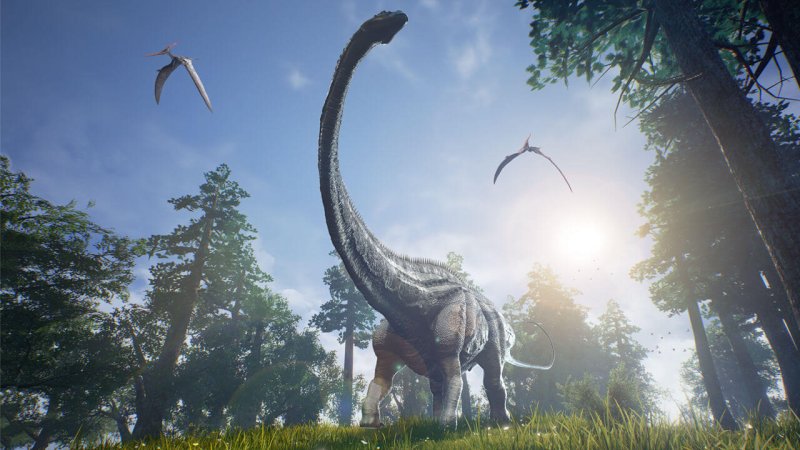
All the species went extinct except dinosaurs, crocodiles, turtles, and early mammals. This is known as the Triassic-Jurassic Extinction Event. In this period, dinosaurs dominated the Earth as most of the reptile species went extinct. Dinosaurs grew in size through evolution. For example: Titanosaurus that emerged 160 million years ago was a 15,000 kg giant with a length of 15 meters. Other important dinosaur species in this period were Brachiosaurus, Diplodocus, and Stegosaurus. Flying dinosaurs also evolved in this period. Archaeopteryx is believed to be the oldest feathered dinosaur. The Jurassic period ended 145 million years ago.
The Cretaceous Period
In this period, an explosion in the diversity of the dinosaur species was seen. The T. rex emerged in this period. Although all the movies by name ‘Jurassic’ depict T. rex in the era, T. rex actually emerged nearly 80 million years after the Jurassic era, and they dominated the planet in the later part of the Cretaceous era. T-Rex were 40 feet in height and was known as the Apex predator. Continents were formed in this period from the two supercontinents. Grass evolved in this period, some 70 million years ago. Almost every single species of dinosaur emerged in this era. Orinthomimids were an ostrich-type dinosaur that could run at a speed of 80 km/h, the fastest among all other dinosaurs. Quetzalcoatlus was a large flying dinosaur with a wingspan of 10-11 meters.
The Killing Asteroid
The Cretaceous period ended with a dinosaur-killing asteroid some 66 million years ago. The asteroid that wiped out the entire species of dinosaurs was 10-15 km in size and hit the Yucatan Peninsula in Mexico with a speed of 30 km/s. The impact created a 180 km wide crater, and the amount of energy released was equal to 100 teratonnes of TNT or 1 billion times more energy than was released in atomic bombs used in WWII. The initial impact filled the air with dust, the earth’s surface became extremely hot, hot dust fell like rain, and animals within a 1000 km of range were cooked instantly.
Only small animals survived that went underneath in the land, or in deep waters, or in tree trunks. After the initial impact, the animals in the other parts of the planet became extinct in shock waves, heat pulses, wildfires, Tsunamis (2 km high tsunamis estimated), volcanic eruptions, acid rain, and earthquakes. The dust particles in the air blocked the sunlight for years, causing the nuclear winter. The temperatures on the planet went as low as freezing.
The blockade of sunlight by dust particles stopped the photosynthesis that ultimately halted the food chain, which killed the insane amounts of animals. Only those animals survived this catastrophe who were omnivores and scavengers, including mammals, lizards, turtles, and birds. In this catastrophe, approximately 75% of the species went extinct and put an end to the dominance of dinosaurs.
The Paleogene Period
After the end of the Cretaceous period with a bang, the Paleogene period started. In this period, species of horses, bats, whales, primates, snakes, and lizards evolved. The flying dinosaur species that survived evolved into birds. Scientists know about this asteroid because of the dating of Iridium. Iridium is a rare earth mineral, but it is found in high concentrations in the ground. When scientists researched, they found out that comets and asteroids contain huge concentrations of Iridium. The impact must have spread the Iridium from the asteroid to all over the planet.
Cenotes sinkholes in Mexico in ring shape are actually the real-world impact of the asteroid and together they form the largest network of caves in Mexico.

There are thousands of near-earth asteroids that may hit Earth. But with the advancements in science and technology, scientists can easily predict the path of asteroids and estimate the chances of its collision. To change the direction of these asteroids, NASA experimented with the Double Asteroid Redirection Test (DART) in 2022. A spacecraft was to hit an asteroid that would change its path and it was a success.
Conclusion
Although the asteroid killed dinosaurs, it was the start of new species and ultimately Homo Sapiens. That was the 5th extinction event, but unfortunately, scientists claim that we are already into the 6th extinction event, as humans are causing the loss of biodiversity, pollution, and deforestation, which is leading to the mass extinction of species. We evolved some 300,000 years ago. If we want to live long, we must work as a unit to protect the environment; we may not be able to live even a million years.