Over the years, a number of brilliant minds have been born who paved new ways in the development of science. Among such scientists, Newton tops the list. Admired by great scientists of modern times like Michio Kaku or Neil deGrasse Tyson, Newton stands out as an absolute genius. Neil DeGrasse Tyson in an interview, put Newton ahead of Albert Einstein. But how did he become the greatest of all time? Let’s dive into the story of the Great Issac Newton.
Background
Newton was born on 25th December 1642; the same year Galileo died. He was born in Lincolnshire County, England, in a time when science was just emerging. Newton was basically from a troubled family. His father had died 3 months before his birth, and when he was three years old, his mother married a rich man who refused to adopt him. So, Newton grew up with his grandparents.
The time of abandonment actually shaped his personality with many darker traits like aloofness, extreme obsession, and less trust in people. He later made a list of sins he had committed, in which he also stated that he was once so frustrated that he actually thought of burning his mom and step-dad alive.
Education
Just a few years later, his stepfather, Barnabas Smith died, and his mom came back to live with him. At the age of fifteen, his mom wanted him to quit studying and work in the field as a farmer. But Newton kept solving mathematical problems in the field. He was actually good at Mathematics from his early childhood. So, the headmaster of his school insisted that his mom send Newton to Cambridge for higher studies. Newton was sent to Cambridge, which would be a new chapter in the life of Newton.
When Newton went to Cambridge, he noticed that the concepts of science being taught there were outdated. Alumni were made to study Aristotelian physics. According to Aristotelian physics, every object has a tendency to be in a state of rest. Heavy objects have a greater tendency of state of rest, that’s why heavier objects would fall earlier than lighter objects.
But, this idea was rejected by Galileo in 1589, when he dropped two balls of unequal weight yet the same physical volume from the Leaning Tower of Pisa; he noticed both balls struck ground at the same time if air resistance was not taken into account. So, Newton started to study books of Galileo, Copernicus, Descartes, and Cavalieri all by himself to get an updated knowledge of Science. He also wrote a special notebook by the name ‘Quaestiones Quaedam Philosophica’ in which he wrote about philosophical questions. He wrote about Plato and Aristotle:
“Aristotle is my friend, Plato is my friend, but my best friend is my Truth.”
Discoveries
After four years of self -studying and observing the motion of the objects, two main questions arose in his mind. Is there any force that causes this tendency of objects to be at rest? And, is it the same force that causes the objects to fall and the moon to revolve around the Earth? At this point in time, Kepler’s laws of planetary motion were discovered. After close analysis and deep studies, he came to the conclusion that there is a force named ‘Gravitational Force’ that causes objects to fall and the moon to be in orbit. Newton discovered gravity when he observed an apple falling in the garden.
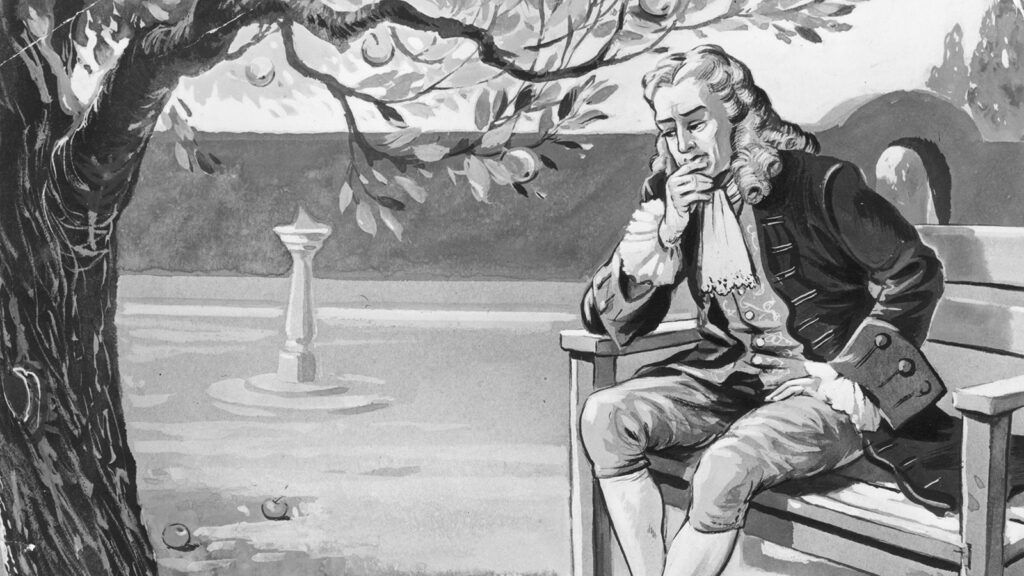
He also predicted the velocity at which objects should move in orbit around Earth. He imagined it with a Cannonball illustration. After some calculations, he estimated that if an object moved with a velocity of 7.9 km/s, it would orbit around the Earth. If the velocity decreased, the object would fall, and if the velocity increased to 11.2 km/s, the object would leave the orbit known as ‘Escape Velocity’.
Calculating the speed of the falling object was easy, just dividing the distance by time. But for calculating the speed of objects at specific seconds during a fall, Newton invented a whole new branch of mathematics named ‘Calculus’. Calculus was used in the later discoveries of science. It describes motion like the equation of falling objects, it describes electricity and magnetism like Maxwell’s equations, it describes general relativity like Einstein’s general theory of relativity, it describes Quantum mechanics like Schrodinger’s equation, and it also describes Thermodynamics.
After corroborating the years of hard work, motion of falling objects, and Kepler’s third law of planetary motion, Newton gave the Law of Universal Gravitational Force, also known as the Inverse Square Law. He documented the Law of Universal Gravitational Force along with three laws of motion in a book named ‘Philosophiae Naturalis Principia Mathematica’.
Newton also calculated the speed of sound. Although there was an error of roughly 17% in his calculations, which were later rectified by Laplace because he had taken the adiabatic process into account. Newton also studied light and experimented with prisms, concluding that sunlight is made up of seven different colors of light. Newton remained a professor at Cambridge. He died on 31st March 1727.
Conclusion
So much contribution in science by him, that’s what makes him the genius of all time. Although some of his discoveries were later ratified by other scientists, such as the relative speed of light. Newton said that speed is relative, but Maxwell stated that the speed of light is constant for all observers, whether at rest or in motion. This concept was later proved experimentally by Michelson and Morley. Einstein claimed that there is no force like ‘Gravity’, it is just the curvature of the space-time fabric. The more the mass of an object, the more the curvature. But, overall, his discoveries are the torchbearer of the discoveries in science that would shape the future of humanity.