It does not get any more thrilling than this idea of entering a sleek metallic chamber, typing a date into a futuristic dashboard, and observing events such as the French Revolution or the building of the pyramids take place right before your eyes. Time traveling back seems like a true final frontier in sci-fi.
However, while scientists have been debating about the ability to bend space-time and thus travel forward into the future (a secret tip from Einstein is that we can do so using either velocity or gravity), going back into time appears to be impossible due to the fundamental principles of physics. As per our current comprehension of the universe, time traveling backwards is not only impractical but also theoretically impossible. Let us discuss why.
1. Thermodynamics and the Arrow of Time
To explain why there’s no way to go back, one needs to consider the universe’s unidirectional highway known as entropy. From the viewpoint of fundamental physics, the majority of microscopic equations possess a symmetry, meaning they are valid in either direction – backwards or forwards. Yet, the macroscopic world obeys the Second Law of Thermodynamics, according to which, in an isolated system, entropy must always rise over time. Imagine an egg being dropped on the floor and breaking into pieces, thus entering a highly disordered state. To go back in time and return to the moment when the egg was whole, one would need to reduce the entropy of the universe; yet, such a thing is impossible due to the Second Law. The increasing amount of entropy defines what is called the Arrow of Time, suggested by British astronomer Arthur Eddington. The universe as a whole expands and grows entropic; therefore, going back would mean ignoring its very basis.
2. Special Relativity and the Cosmic Speed Limit
Time was forever altered by the Theory of Special Relativity from Albert Einstein. According to him, time and space are not two different things but rather one four-dimensional fabric known as space-time.
While relativity offers a mathematical loophole to travel back in time, because mathematically if someone travels faster than the speed of light, then their time would move backwards relative to an outside observer. However, Einstein’s theory also protects this barrier with a physical catch as harsh as the concept itself. With increasing acceleration towards the speed of light, the relativistic mass of the object also increases. To achieve the speed of light exactly, one would need infinite energy. While surpassing it would demand energy beyond infinity, or that mass becomes an imaginary number, both concepts lack any physical existence. Since no information or mass can ever break this barrier in the cosmos, we cannot simply outrun time with speed.
3. General Relativity and “Closed Timelike Curves”
However, while Special Relativity does not allow faster than light motion, there are a number of theoretical loopholes that exist in General Relativity, which describes the theory of gravitation as curvature of space-time by matter and energy.
Solutions that allow Closed Time-like Curves (CTCs) have been found by physicists such as Kurt Gödel and Kip Thorne from the equations of Einstein. A CTC is a looped path in the space-time continuum wherein the traveler returns to his own past.
There is cosmic anomaly that theoretically may create a CTC:
An Einstein-Rosen bridge or wormhole is basically a tunnel in space-time connecting two distant points. In order to create a CTC, one would have to stabilize the wormhole and accelerate the opening of it almost to light-speed, thereby creating time dilation. Going through the stationary opening could therefore send you into your past.
The Catch: Cosmic Censorship and Exotic Matter
Although such a solution may appear wonderful in theory when solved on the blackboard, it appears that nature has a built-in countermeasure to any such scenario. For a wormhole to stay open, we need the presence of exotic matter with negative energy density. It is important to note that no exotic matter in adequate amounts is known to exist, which would make a wormhole stable enough to pass through time.
Another interesting concept proposed by the physicist Stephen Hawking is the Chronology Protection Conjecture. According to him, the very laws of nature work in such a manner as to prohibit any kind of closed timelike curves from forming, thus making sure that the historians are always safe. The moment such a curve starts to form, there will be an infinite feedback of energy due to quantum fluctuations of the vacuum in it, leading to its instant destruction.
4. The Backbreaking Paradoxes of Causality
Aside from the practical difficulties involved, going backwards in time would also create logical problems capable of tearing the very fabric of cause and effect to pieces. The universe depends on causation—that is, that a cause precedes an effect. Time travel backward breaks that rule.
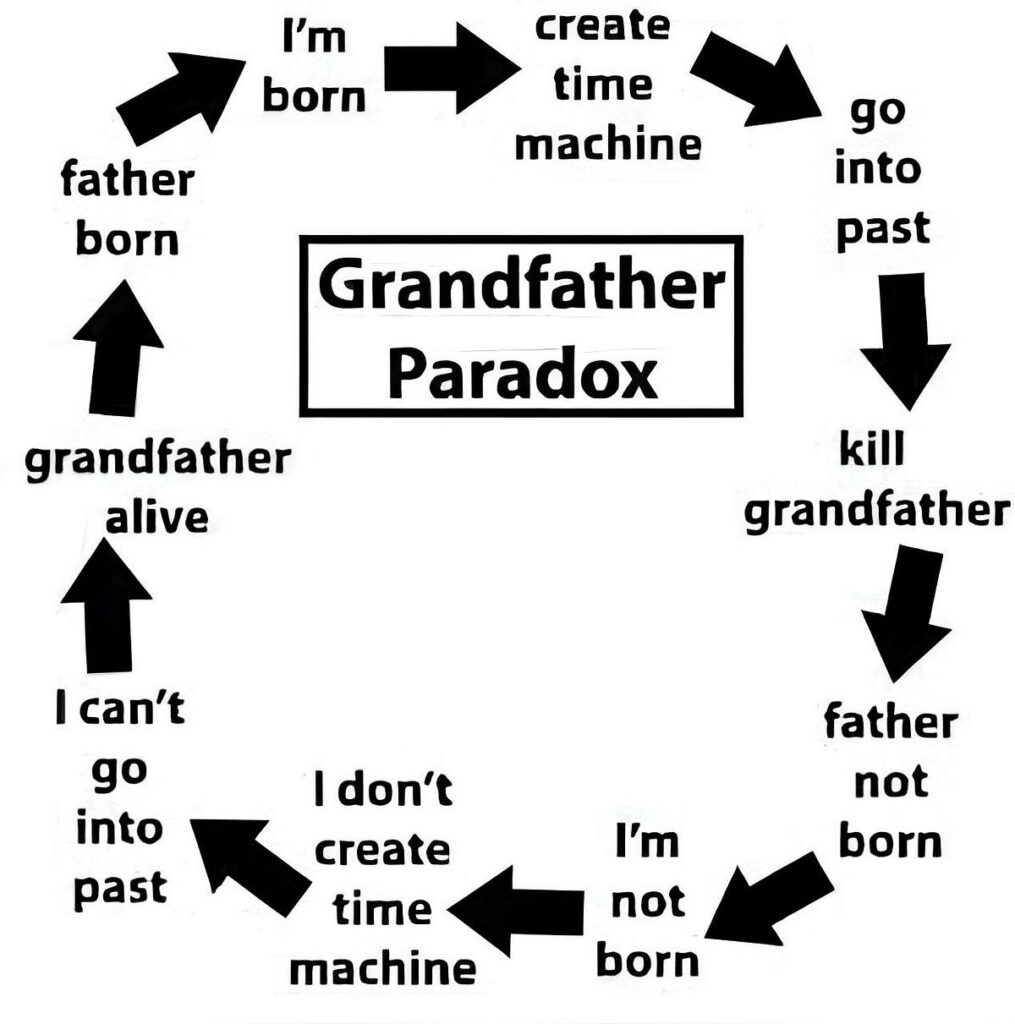
The Grandfather Paradox
The classic example of a logical conundrum in connection with time travel is the grandpa paradox. For example, if you create a time machine, travel back to 1950, and successfully manage to manipulate circumstances such that your grandpa never meets your grandma, then your parents will never exist, and neither will you. And if you don’t exist, then obviously you couldn’t have invented a time machine in the first place.
The Bootstrap Paradox
Another possibility is that you go back in time to visit William Shakespeare when he was still young and give him a copy of Hamlet. Shakespeare makes a carbon copy of Hamlet and publishes it. Who then really authored Hamlet? Information has no true origin since it was created out of thin air.
According to some physicists, these kinds of paradoxes may be solved through the Many Worlds Interpretation of quantum physics, wherein going back in time does not affect one’s own timeline but only creates another parallel universe. In this case, you do not really go back into your past but rather into another universe.
5. The Absolute Motion of the Universe
The third issue with backward time travel is that there is another extremely practical, yet largely ignored mechanical problem associated with this process: the universe is moving.
“When we talk about going back ‘to this very spot, twenty years ago’, we don’t realize that the planet is moving,” and spinning on its own axis at a speed of about 1,600 kilometers per hour, and is simultaneously rotating around the sun at 107,000 kilometers per hour while traveling through the solar system which revolves around the center of the galaxy at an astounding 828,000 kilometers per hour.
If one were to step into a time machine that would only change his time location and not his physical location in space, he would find himself floating in the void millions of kilometers away, where the planet would have been one year ago. The perfect time machine would also be the perfect space machine that would know the exact coordinates of this wildly moving universe.
Final Thoughts: The One-Way Universe
Although physics does provide a minuscule, alluring gap through relativity for traveling into the future, it is extremely possessive about the past. The Arrow of Time, which is protected by the laws of thermodynamics, the light speed barrier, quantum physics, and the absolute laws of causality, assures that our past remains safe.
At least for the time being, the only way in which we can actually go back in time is by looking upwards into the sky. Since light needs time to travel across cosmic distances, observing stars which are located several light years away from us means that we are actually observing them several years ago.