Humans belong to the species “Homo Sapiens”, but have you ever thought about where humans came from? How did we evolve from the Apes? Are we still evolving? Let’s learn about the evolution of humans in detail.
The Evolutionary Tree
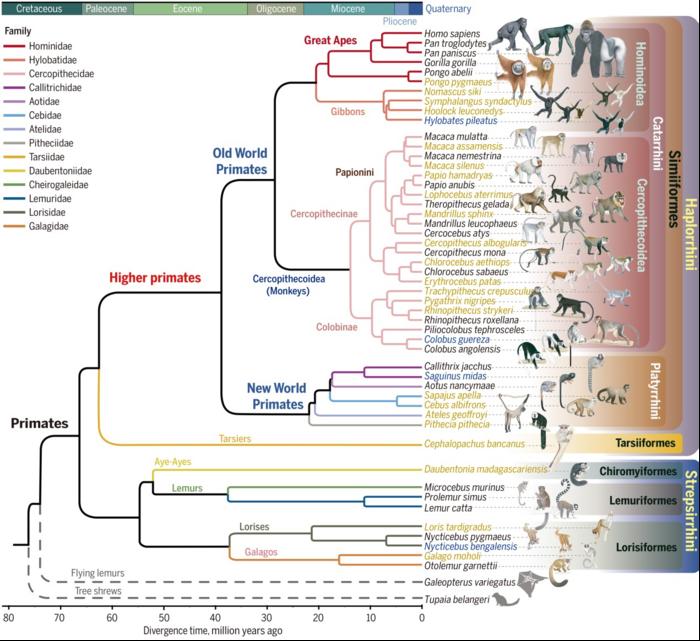
The great apes are the closest human relatives, and together they form a group called ‘Hominids’. The great apes are Chimpanzees, Gorillas, Orangutans, and Bonobos. Human DNA is 99% similar to that of chimpanzees’ DNA, 98% similar to the DNA of Gorillas, and 97% similar to the DNA of Orangutans. In Hominids, a tail is not found. Bipedalism can be observed (more common in Humans), every member has the same blood group types as human blood, and the great apes know human sign language. Hominids, along with the lesser apes, including the 20 species of Gibbons, form the group called ‘Hominoids’. All the members of this group have no tail, and they have trichromatic colour vision.
If we take one step back, Hominoids, along with monkeys, are categorized into the group ‘Anthropoids’, which literally means ‘Resembling Humans’. Monkeys include 130 species of Old World monkeys and 120 species of New World monkeys. And, if we take one more step back, the Anthropoid along with Tarsiers and Lemurs, are classified into a major group named ‘Primates’. All primates have prehensile hands, a lesser sense of smell, prefer living in groups, and show complex social behaviour.
Primates evolved some 60 million years ago. In 2012, a fossil was found in Montanna, believed to be 65 million years old. Scientists claim the primates evolved from the earlier ancestor known as ‘Purgatorius’. The primates are Arboreal (Tree dwellers).
The tail disappeared in Hominoids, and ‘Proconsule’ is believed to be the first Hominoid without tail due to a mutation in Gene TBXT. The possible reason behind this mutation is believed to be the evolution of Bipedalism. In this evolutionary tree, there is a common ancestor at every starting point of the group.
The Hominins
There is a group named ‘Hominins’ which include humans and human-like species that are extinct. In Hominins, Ardipithecus Ramidus is the first ancestor to have Bipedalism. They evolved 4.4 million years ago in East Africa. One study suggests that bipedalism at first wasn’t frequent; it was occasional. Australopithecus Afarensis who evolved some 3.7 million to 3 million years ago were proper committed bipedals. In 1974, in Ethiopia, a fossil of Australopithecus Afarensis was found, which is called ‘Lucy’. This group was omnivores and they used the already sharpened stone tools.
Homo habilis, meaning ‘Handy man,’ evolved 2.5 million to 1.5 million years ago. Fossils were found in Tanzania and Kenya. Their height was 3- 4 feet. They were not hunters, they were scavengers. They used stone tools for meat cutting and they are believed to consume the Bone Marrow that would increase their brain size. At the same time, there was another species by name ‘Paranthropus’ which was vegetarian and became extinct due to the scarcity of food.
Homo Erectus, also called Homo Ergastor known as ‘Working man’, evolved 1.9 million to 0.14 million years ago. Their hands were short with larger feet. They were fruit gatherers and hunters. They are believed to preserve the meat. They are titled to be the first species to have controlled use of fire. We know this because the traces of purposeful fire were found at Wonderwerk cave in South Africa, and when these traces were carbon-dated, they appeared to be some 1 million years old. They learned to cook the meat, which resulted in extra energy that contributed to increasing their brain size to 900 cubic cm. Their teeth and digestive system were smaller, they lived in groups, had social interaction, and there was no true language, but they used to communicate through Proto-language.
Homosapiens
Homosapiens, meaning ‘Wiseman,’ evolved some 300,000 years ago. Some scientists argue that those Homosapiens who evolved earlier were different from nowadays Homosapiens. Scientists call them Archaic Homosapiens, who would have lasted till 150,000 years ago, and the other group is Modern Homosapiens, who evolved 160,000 years ago. At this point in time, their brain size had increased to 1350 cubic cm, which developed abilities like art and abstract thinking in the species. Homosapiens moved to all parts of the world.
Evolution does not take place in a single direction; it takes place in all other possible directions. There were other species like Homo Neanderthals, Denisovans, and Hobbits that went extinct due to some reasons. Among them, Homo Neanderthals are prominent, which evolved some 400,000 years ago and went extinct approximately 40,000 years ago. The species is called Neanderthal because the first ever fossil of the species was found in Neander Valley, Germany, in 1865. They lived in cold areas with higher latitudes of Europe and Asia. Due to their cold habitat, their body developed a few changes, including a larger nose, wider hips and shoulders, and a prominent brow ridge. The species is considered to be intelligent because they were involved in painting, used to decorate their body with feathers, had listening and speech abilities, and they used to bury their dead members. Their overall population is estimated to be 5000 members that went extinct 40,000 years ago due to climate change in Europe, resulting in intense cold.
45,000 years ago, Homosapiens spread to all parts of the world. Scientists believe that Homosapiens and Homo neanderthalensis must have interbred. That must be the reason we see 2% Neanderthal DNA in some of the humans.
Are we still evolving?
Evolution is a continuous process. Anthropologist Nina Jablonski and George Chaplin argue that the skin colour gradient in humans is the result of evolution. Thousands of years ago, those who migrated away from the equator, their body faced less ultraviolet rays, and their skin became white. Serbian Asians and Eskimos have fat padding around the eyeballs known as the epicanthic fold. This layer protects their eyes from direct cold exposure and is believed to be the result of evolution. Evolution doesn’t occur within years; it is a slow incremental process. If we imagine the billions of years of evolution, we will come to know that life evolved from Stardust. Evolution takes time.