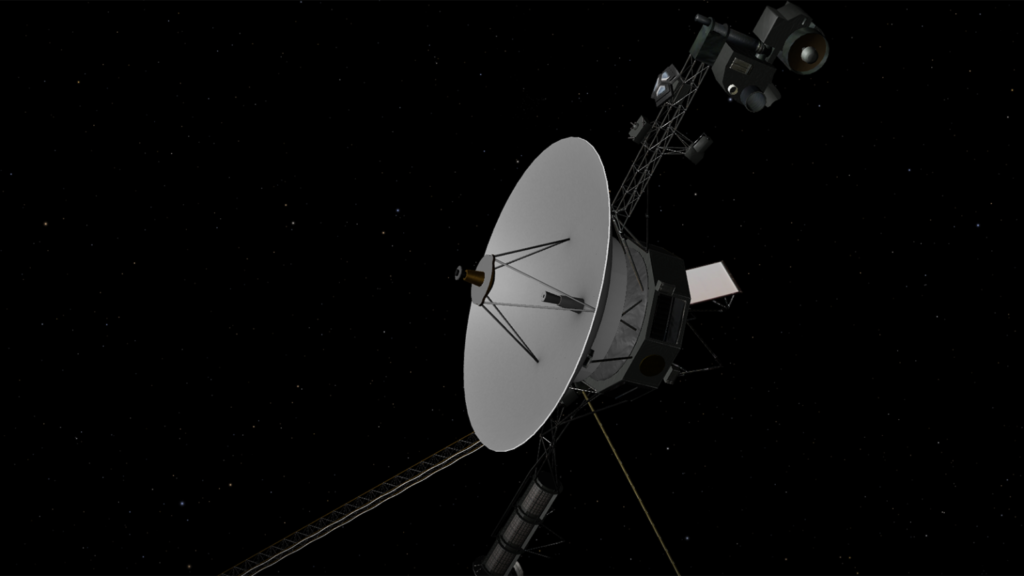
Out there in the darkness of deep space, a spacecraft by name Voyager 1 silently carries the fingerprints of a civilization that is—or perhaps once was—driven by curiosity, reaching out in search of life beyond its own world. Voyager 1 is the farthest human-made spacecraft and is currently moving at a speed of about 38,000 mph into interstellar space. Back in the mid-1960s, NASA scientist Gary Flandro observed that in the late 1970s, the outer four planets—Jupiter, Saturn, Uranus, and Neptune—would align in such a way that a single spacecraft could visit them using gravity assist, without requiring a massive amount of fuel. Recognizing a chance that wouldn’t occur again for another 176 years, NASA launched Voyager 1 on September 5, 1977, just two weeks following the launch of Voyager 2. The names of both spacecrafts are determined by NASA’s mission design sequence rather than their launch dates.
Voyager 1 is equipped with three Radioisotope Thermo-electric Generators (RTGs). These RTGs use Plutonium-238; as this radioisotope undergoes decay, it produces heat that is converted into electricity, which powers the spacecraft. The spacecraft is not fitted with solar panels because they would be ineffective beyond Mars, where the intensity of sunlight decreases as the distance from the sun increases. Furthermore, the spacecraft was fitted with ten distinct scientific instruments. Among the key instruments are an Imaging Science Subsystem (ISS) for taking photographs, an Infrared Spectrometer, an Ultraviolet Spectrometer, a Magnetometer to assess the magnetic fields of planets, a High Gain-Antenna for communications, along with few other tools.
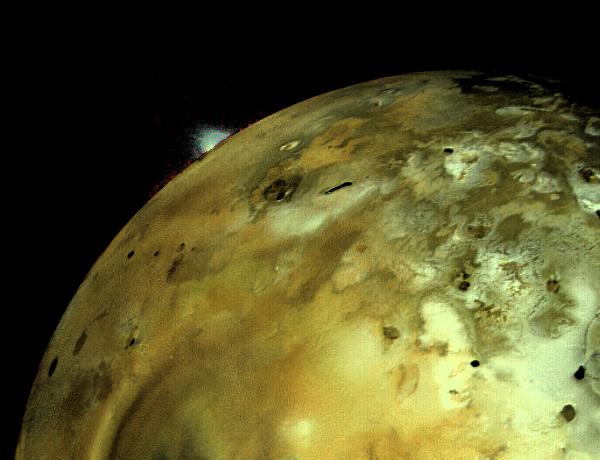
On March 5, 1979, Voyager 1 arrived at Jupiter and discovered that the planet has faint ring system similar to Saturn’s, although these rings cannot be seen from Earth. Jupiter, along with its rings and moons, constitutes the Jovian system, while Jupiter and the other gas giants are referred to as Jovian planets. During its flyby, Voyager 1 captured nearly 19,000 photographs of Jupiter and its satellites, including detailed images of Europa, a crescent view of Jupiter, and notably, pictures of volcanic activity on Jupiter’s moon Io, marking the first time humanity observed such activity on an outer space body.
In November 1980, Voyager 1 arrived at Saturn and captured remarkable images of the planet, its rings, and its moons. It also studied Titan, Saturn’s largest moon. Scientists discovered that Titan has a thick atmosphere that completely hides its surface. This atmosphere is mainly composed of nitrogen, methane, and hydrocarbons. The surface pressure on Titan is about 1.45 times that of Earth. After completing its observations, Voyager 1 continued its journey beyond the Solar System, travelling at an angle of about 35° north of the ecliptic plane.
On Valentine’s Day, February 14, 1990, at the request of Professor Carl Sagan, NASA turned the cameras of Voyager 1 one final time from a distance of 6 billion Kilometres. The spacecraft captured a series of 60 images that together form the “Family Portrait of the Solar System.” This collection famously included the “Pale Blue Dot” image of planet Earth.
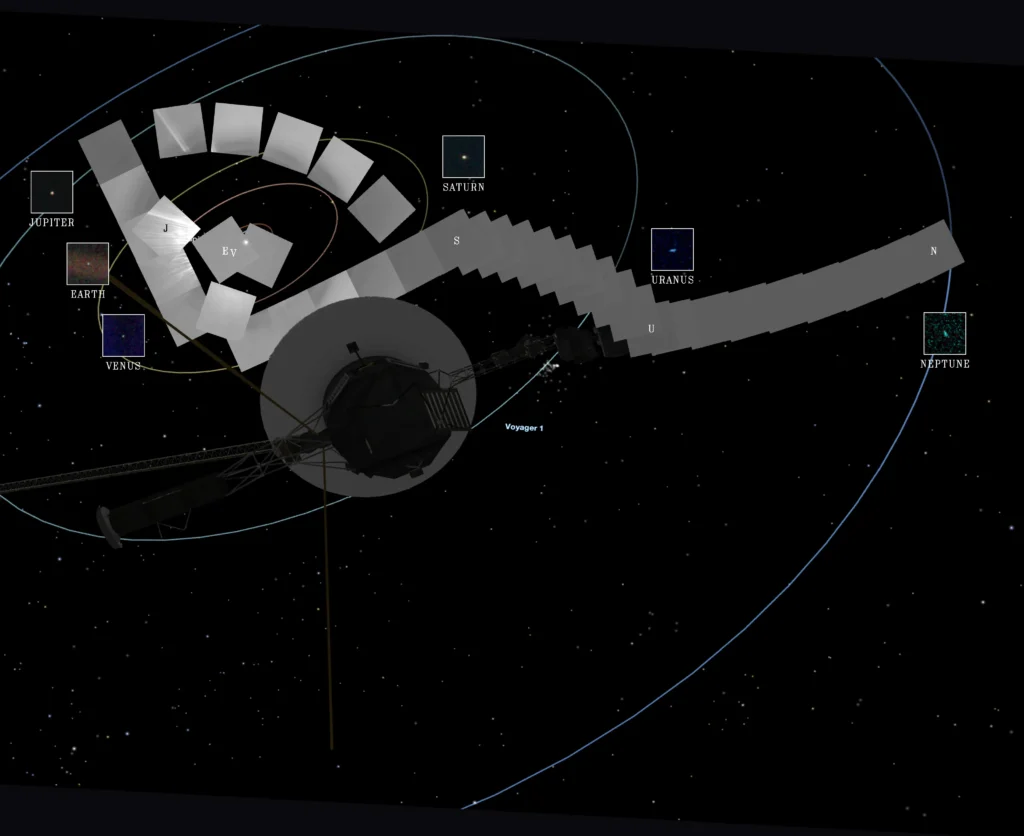
The image depicts the “Family Portrait” of our solar system. Mercury is missing because it was too close to the Sun to be captured, while Mars was obscured by the scattering of sunlight. Additionally, Pluto—which was still considered a planet at the time—was too small and faint to be detected by the spacecraft’s cameras.
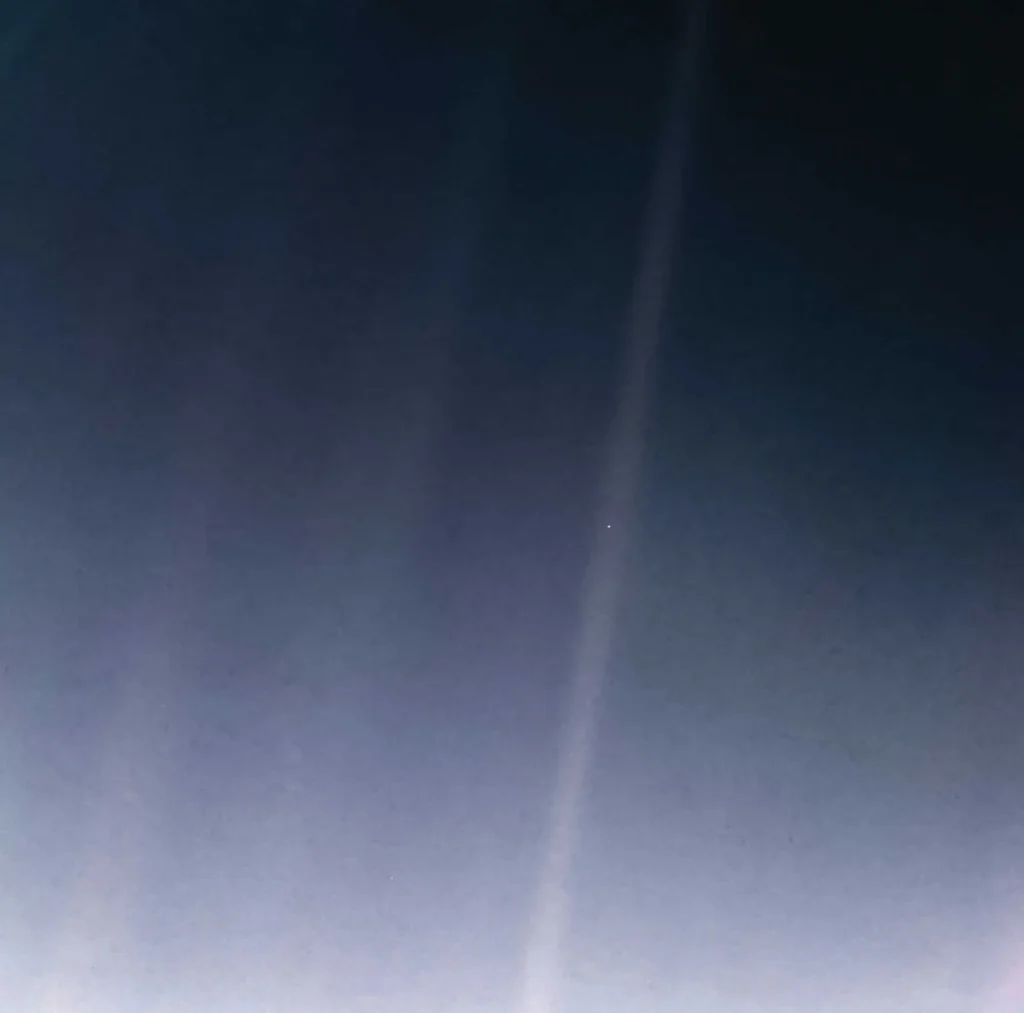
This picture depicts Earth as a tiny dot in the vastness of space. Looking at the image, one can truly sense the fragility of our planet—an oasis in the desert of deep space, a tiny island in an unimaginable ocean. From this perspective, there is a sense of complete silence; no fuss, just serenity in motion. All we have is this “Pale Blue Dot.” From this vantage point, the differences between atheist and theist, Black and White, rich and poor, or insane and intelligent seem to vanish. We are simply an advanced species, roaming this beautiful planet amidst the quiet, vast nothingness.
After capturing these final images, NASA shut down Voyager 1’s cameras to conserve power for its journey into the deep unknown. On August 25, 2012, the spacecraft officially entered interstellar space, crossing the final boundary known as the Heliopause—a space where the pressure of solar winds is balanced by the pressure of the interstellar medium. Interestingly, August 25, 2012, was the exact day on which the first man to walk on the Moon, Neil Armstrong, died.
Beyond its scientific instruments, Voyager 1 carries a lasting testament to humanity’s existence into the depths of space: the Golden Record. This 12-inch, gold-plated copper phonograph disc contains four distinct types of data designed to represent our world:
- Scenes from Earth: A collection of 115 images and diagrams portraying life on Earth, various species, our location in the solar system, mathematical formulas, and definitions of physical units.
- Greetings from Earth: Spoken greetings in 55 different languages, alongside a signed message from then-US President Jimmy Carter and UN Secretary-General Kurt Waldheim.
- Music from Earth: A 90-minute selection of 28 audio recordings featuring music from a wide array of cultures.
- Sounds of Earth: A diverse soundscape of 21 recordings, ranging from the songs of birds to the sounds of human machinery.
Although the record contains no negative photos of wars or emergencies, this was an intentional choice to convey the message that our planet is habitable and that the species living here are peaceful and loving.
Even after 48 years, Voyager 1 remains a lonely sentinel 25.39 billion kilometers away—a distance so vast it takes light approximately 23.5 hours to cross it. It carries the echoes of a civilization that has existed for a mere 200,000 years, a heartbeat in cosmic time. Though its power is fading and our conversation with it will soon go silent, Voyager 1 will endure. Long after we are gone, this small craft will continue its journey through the stars, carrying the fingerprints of our curiosity into eternity.