Engineering a 6-Million-Ton Marvel
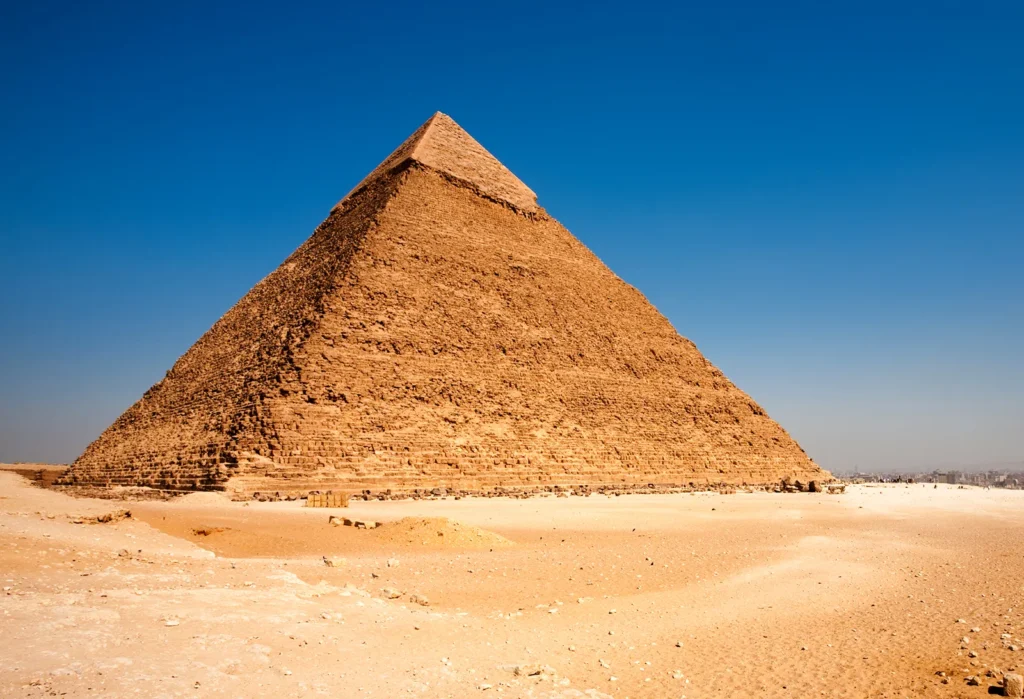
On the western bank of the River Nile stands the Great Pyramid of Giza. This marvel of human ingenuity has endured earthquakes, floods, and the passage of generations. It is also the oldest among the Seven Wonders of the Ancient World.
Standing at 146.6 metres, it remained the tallest human-made structure for more than 4,000 years. Its total weight of 6 million tons dwarfs modern icons like the Burj Khalifa, which weighs only 500,000 tons. This raises a profound question: how was such a massive structure built before the invention of modern machinery or even the wheel?
Construction and Composition of The Great Pyramid of Giza
Pharaoh Khufu built the Great Pyramid around 2560 B.C.E. It contains 2.3 million blocks, weighing between 2.5 and 80 tons each. The blocks were cut and polished with Copper. The structure uses 5.5 million tons of limestone, 8,000 tons of granite, and 500,000 tons of mortar. Scientists know the chemical composition of this mortar, but still cannot recreate it.
About 20,000 to 30,000 people worked 10 hours a day to finish the monument in 20 years. Many people believe these workers were slaves. However, they were actually skilled laborers who were well-treated. The state provided them with good food, clothes, and housing. Professionals from many fields also arrived to assist with this massive national project. Other famous sites from this time include the Great Sphinx and the pyramids of Khafre and Menkaure.
The Purpose of the Pyramids
Ancient Egyptians believed in the afterlife. They built these pyramids so that when they died, their bodies could be mummified and placed inside. They also stored food, clothes, and other luxurious items to help the Pharaoh live in the afterlife.
In 1998, Christopher Dunn proposed a theory that the Great Pyramid of Giza may have been used as a power plant. He suggested that the pyramid could have converted the Earth’s natural vibrations into electromagnetic energy. However, this idea is not supported by mainstream historians or scientists and is based on his interpretation of ancient artwork and architectural features.
Another claim was made by Ben Carson, who suggested that the pyramids were used as granaries built by the biblical figure Joseph.
Construction Theories of the Great Pyramid
By the time the Great Pyramid was built, the wheel had not been invented. So, how exactly were these heavy blocks moved and placed? A number of theories have been presented to describe how the Great Pyramid was built:
- The Raft Theory: The heavy blocks must have been transported via raft and sailed through the Nile.
- The Wet Sand Theory: The explanation proposed by physicist Daniel Bonn is that Egyptians might have placed blocks on sledges and pushed the sledges by wetting the sand in front. This reduces friction, so less force is applied.
- The Ramp Theory: Another explanation was given by Joseph West. According to him, a ramp must have been made, and blocks could have been pushed by men. A long but not steep ramp would have been necessary for blocks to be transported to the top.
- The Lever Theory: One explanation tells us that there might have been levers used to put the blocks perfectly. This is like the shadoof system used by ancient Egyptians to water their fields from the Nile.
The Geometry of Giants: Precision in Every Block
In a time when there was no compass, no GPS, and no modern navigation tools, the design of the Great Pyramid remains incredibly sophisticated. All four sides point almost perfectly toward the four cardinal directions (North, South, East, and West). Although there is a tiny error of about 1/15th of a degree, it is so small that it can easily be neglected. The best possible explanation for this level of precision is the Autumn Equinox—a time when the sun is directly above the equator, causing the shadow of a rod to move in a perfectly straight line from West to East. This highlights the extraordinary skill of the ancient Egyptians.
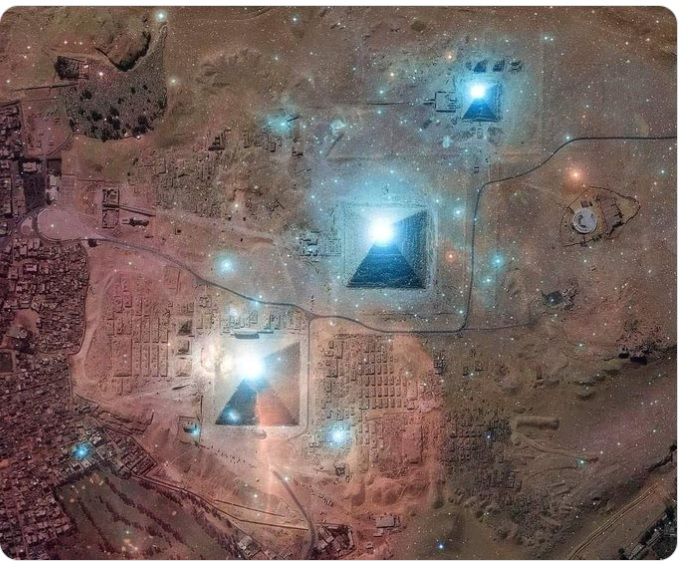
The ancient Egyptians were not only masters of geometry but also of astronomy, and the pyramids are a perfect depiction of their craft. A famous theory suggests that the three pyramids of Giza align with the three stars of the Orion Constellation: Alnitak, Alnilam, and Mintaka. This Orion Correlation Theory was popularized by Robert Bauval in 1989. While there is a slight misalignment today, it is because more than four millennia have passed since these marvels were built, causing the stars to slightly shift their position in the sky.
Conclusion
Though many theories have been suggested about how these giants were built, the actual mystery remains unsolved. Some believe a civilization from outer space was responsible, while others suggest that mythical giants of the Earth constructed them. Yet, the truth remains a deep secret; perhaps only the sun and time truly know the story of their creation. Even after thousands of years, these structures remain intact, and their legacy lives on. These pyramids depict an unparalleled struggle of many years, carrying a story through generations—a candle in the darkness of mysteries.